How to Write a Scholarship Essay That Wins (Step-by-Step Guide)

KEY TAKEAWAYS:
-
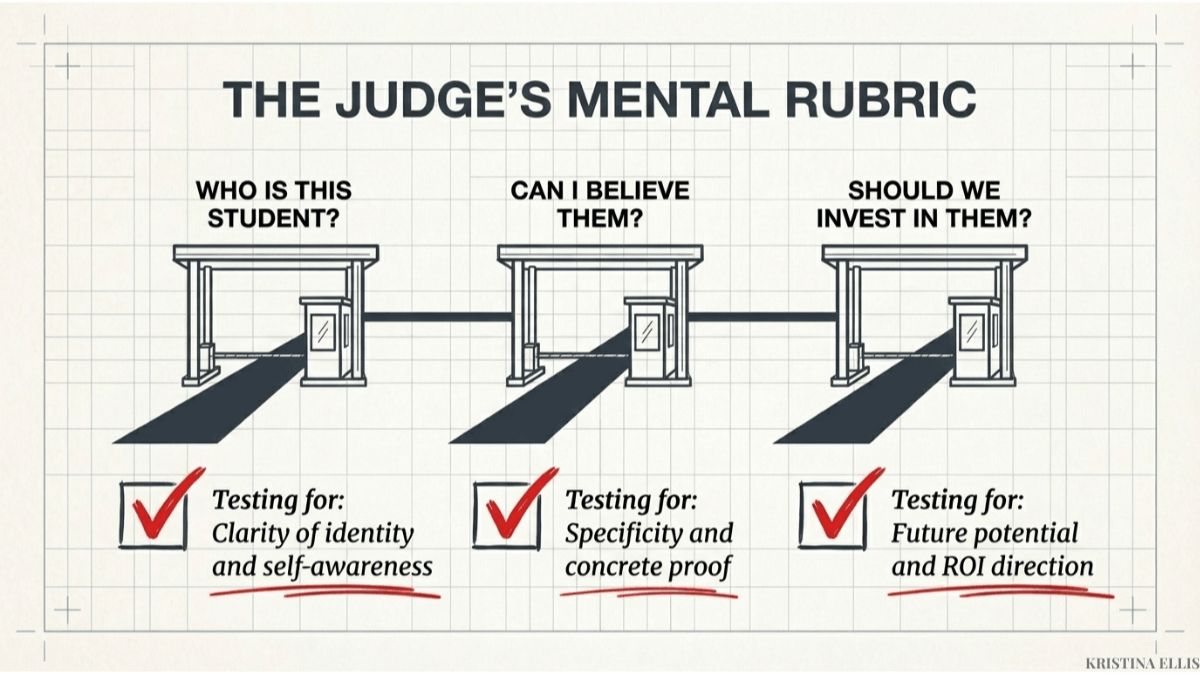
Judges aren't just looking at your grammar. They're asking deeper questions, like: Who is this student? Can I believe them? Should we invest in them?
-
Small, specific moments with good storytelling beat big, dramatic stories almost every time.
-
The Moment-Meaning-Future structure works for nearly any prompt.
-
Specificity (numbers, names, sensory details) is what makes essays stick.
-
Your first draft usually won't win. Revision is where scholarship money is made.
When people ask me how I won over $500,000 in scholarships, they often think it came down to fancy writing. But the truth is, scholarship essays are about making it easy for a judge to pick you out of the stack. In this guide, I’ll walk you through the same approach I used, from understanding what judges really want, to finding your best story, to the step-by-step process that helped my essays stand out.
Most students stumble on the scholarship essay, not because they can’t write, and not because their stories aren’t good enough. The real problem is that they treat it like another school assignment, when it’s actually a tool to help someone decide to invest in you.
I know this from both sides of the table.
I won over half a million dollars in scholarships to attend Vanderbilt University debt-free, including the Coca-Cola Scholarship (top 50 out of 100,000+ applicants) and the Gates Millennium Scholarship (selected from 60,000+ students). I was number 32 in my class of 182. Not the obvious winner on paper. The essays made the difference.
Later on, I found myself on the other side of the table, reading through stacks of scholarship applications. Seeing things from the judge’s perspective completely changed how I understood what actually wins.
From the judge’s side, it’s a numbers game. Committees read hundreds, sometimes thousands, of essays. They’re seeing a lot of the same types of answers and just looking for a reason to say yes to someone.
Most applicants never give judges that reason. They write essays that sound impressive but don’t stick in anyone’s mind. They list achievements but don’t show who they really are. They say they’re passionate, but don’t back it up with a single real moment.
In this guide, I’ll show you how to write a scholarship essay that rises above the pile and actually wins money for college.
Why Most Scholarship Essays Fail (And What Winners Do Differently)
Here's what most students get wrong: they think the scholarship essay is about writing ability. It's not.
A winning scholarship essay isn’t about fancy sentences. It’s about making it easy for a judge to pick you, fast and with confidence.
Scholarship reviewers aren't grading your grammar. They're asking three questions:
-
Who is this student?
-
Can I believe them?
-
Should we invest in them?
If your essay doesn’t answer all three questions in the first few paragraphs, you’re already making it harder for yourself.
The students who win aren’t always the best writers. They’re just better at making their value obvious. They use real examples, not vague claims. They show moments, not just lists of what they’ve done. They make it easy for judges to remember them.
When I was reading applications as a judge, I could tell within the first paragraph whether a student understood this. The ones who got it started with something real. Something specific. The ones who didn't started with sentences like: "Ever since I was young, I have always been passionate about helping others."
After reading 20 versions of that sentence, you start to blur together.
How to Write a Scholarship Essay: The Step-by-Step Process
Step 1: Understand What the Essay Prompt Really Wants
Every scholarship application essay asks a question. But behind that question is a deeper test.
When a prompt says "Tell us about a challenge you've overcome," scholarship providers aren't asking for a sad story. They're testing for resilience, problem-solving, and growth.
When they ask about your career goals, they're looking for direction and purpose, not just a job title.
Before you write a single word, really evaluate the prompt. Ask yourself: What trait or quality is this question really testing?
Common essay prompts and what they actually measure:
-
"Tell us about yourself." → They want to see self-awareness and clarity about who you are
-
"Describe a challenge" → They're testing for grit, resilience, and how you handle difficulty.
-
Do you deserve this scholarship?" → They want evidence of impact and future potential
-
"What are your career goals?" → They're looking for direction, planning, and purpose
-
"How will you use your education?" → They want to see that you can connect learning to action
Once you know what they're really asking, you can choose a story that demonstrates it.
Step 2: Choose the Right Story (It's Not What You Think)
One of the biggest myths about scholarship essays is that you need some dramatic life story to win.
You really don’t.
Scholarship committees have read thousands of essays about sports injuries, mission trips, and family hardship. These topics aren't bad, but they're common. And common topics require uncommon angles to stand out.
I once talked with a close friend who had gone to college on a full academic scholarship. After hearing me speak on scholarships, he said he was grateful his scholarship had been purely academic, because he didn't feel like he had much of a life story to tell. His parents were still married. He'd had a happy childhood. No big obstacles.
I started thinking through what I actually knew about his life and said, "If I were painting the picture of your story, here's what I'd say..."
Justin grew up deep in the woods in Arkansas. No heating or air conditioning. His family got water from the creek in their yard. He went to a rural public school with 18 kids in his senior class. Most students in his situation never became competitive nationally. Justin chose to read National Geographic instead of playing video games, joined academic and quiz bowl teams, and graduated with a 4.0 and a near-perfect ACT score.
That’s a story worth telling. He just didn’t realize it.
The best scholarship essays often come from small moments, not big events. A conversation with a family member. A mistake at a part-time job. A quiet decision nobody else noticed.
Before you start writing, it helps to have your history organized. A story bank and a brag sheet can make this process a lot faster.
What matters isn’t how big your story is. What matters is how clearly you make your point, and how specific your details are.
How to find your best story. Think about moments when you:
-
Made a decision under pressure
-
Changed your mind about something important
-
Helped someone without being asked
-
Failed and kept going anyway
-
Noticed something others missed
These so-called small moments often show more about your character than any big award or accomplishment ever could.

Step 3: Structure Your Essay for Maximum Impact
Most winning scholarship essays follow a simple structure. You don’t have to reinvent the wheel, just use it well.
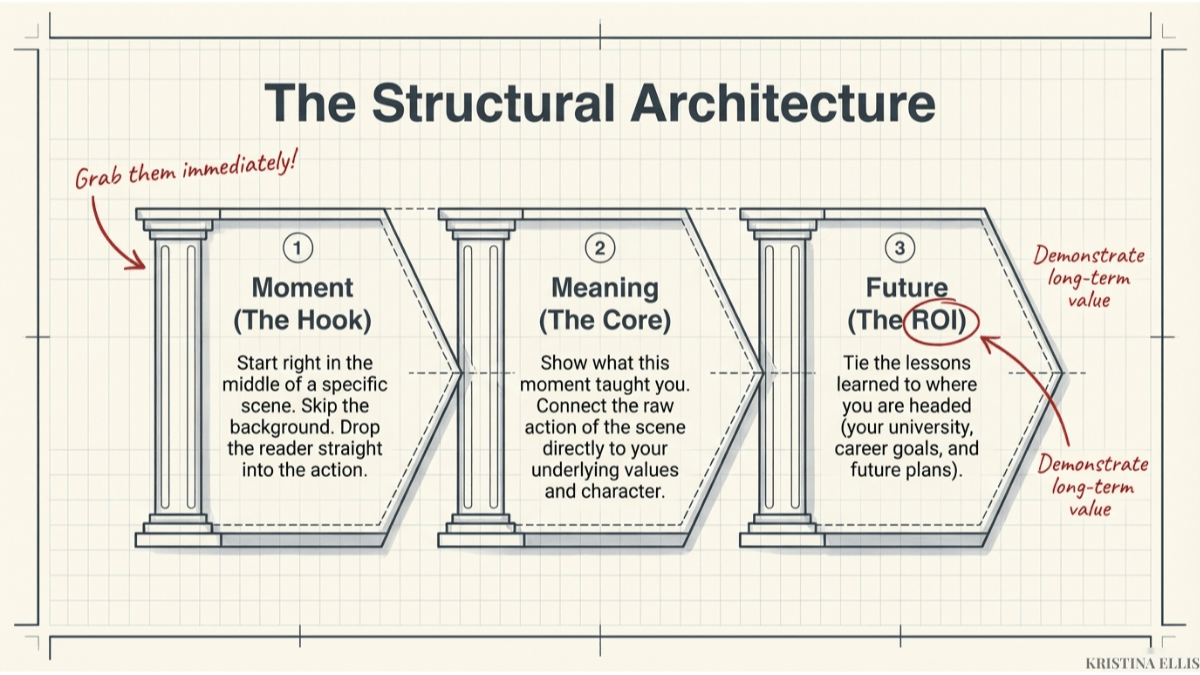
The Moment-Meaning-Future Structure:
Moment: Start right in the middle of a specific scene. Skip the background and context. Just drop the reader straight into the action.
Meaning: Show what this moment taught you, or what it revealed about who you are. This is where you connect your story to your values.
Future: Show how this experience ties into where you’re headed (your education, your career goals, and your plans).
This structure works for almost any essay prompt because it answers the three questions scholarship reviewers care about: Who are you? Can I believe you? Should we invest in you?
Step 4: Write an Opening That Earns Attention
You have about ten seconds to hook the reader with your introduction. If your opening sounds like everyone else’s, you’re already blending into the pile.
What NOT to do:
-
Don't start with a quote.
-
Don't open with "Ever since I was young…"
-
Don't begin with a dictionary definition.
-
Don't lead with background information.
What should you do instead? Start in the middle of a moment. Give the reader some action, a bit of tension, or a detail that makes them want to know more.
Here's an example of an essay I read during my time as a judge that did this well. The student wrote about raising money for a pageant entry fee. Instead of opening with "I've always been passionate about competition," she opened in the middle of a scene, describing selling candy bars every day after school and working in fields on weekends, not knowing if she'd make it, showing up anyway. By the time I finished reading, I knew exactly who she was.
The contrast matters.
Weak opening: "I've always been passionate about helping others in my community."
Strong opening: "The first day I showed up to tutor, I mispronounced every student's name. By the third week, they were teaching me words in Tagalog."
See the difference? The second version puts you right in the scene. It has movement, personality, and makes the reader want to keep going.
Step 5: Show Don't Tell (With Proof, Not Adjectives)
This is where most scholarship application essays fall apart.
Students write sentences like:
-
"I'm a hard worker."
-
"I'm passionate about helping others."
-
"I have strong leadership skills."
These are just claims. And claims without proof don’t mean much to scholarship committees.
In the book I wrote about my own scholarship journey, I called this "humble shamelessness," the art of selling yourself fully while still sounding like a human being. The key is that you can't just say you're remarkable. You have to show it through evidence.
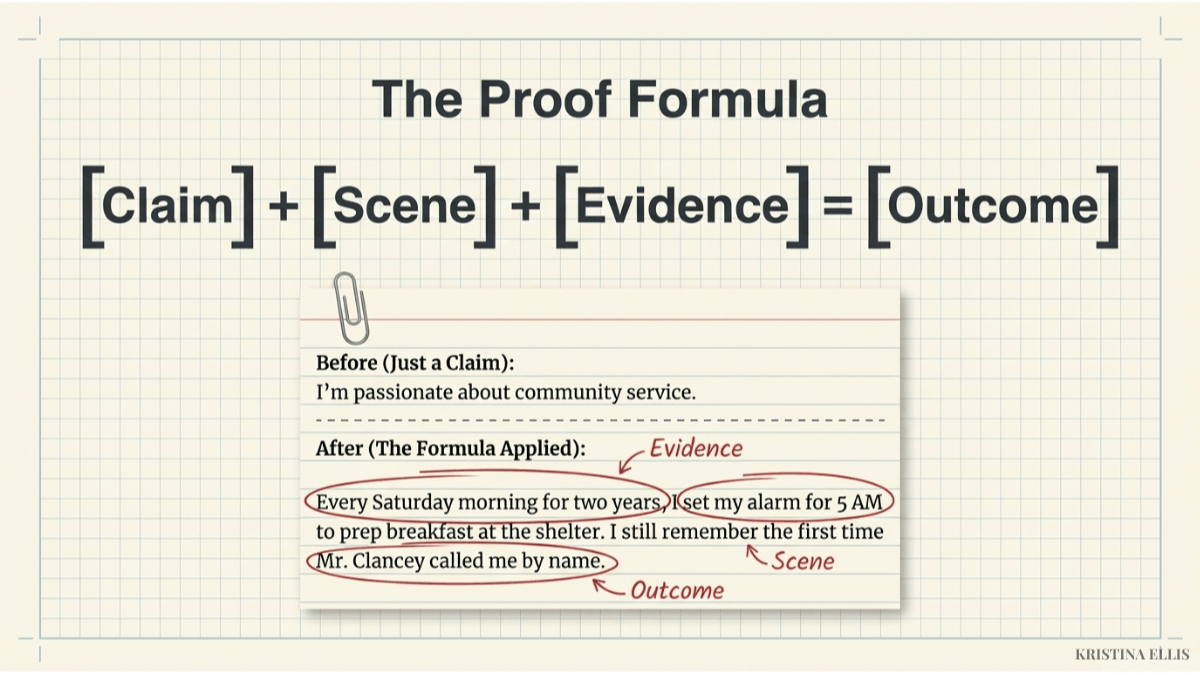
The Proof Formula: Claim → Scene → Evidence → Outcome
Before: "I'm passionate about community service."
After: "Every Saturday morning for two years, I set my alarm for 5 AM to prep breakfast at the shelter. I still remember the first time Mr. Clancey called me by name."
The second version is believable because it's specific. Numbers. Names. Details. These are what make readers trust you.
Step 6: Answer "Why Do I Deserve This Scholarship?" the Right Way
This question trips up more students than any other.
Most students answer by listing their achievements or talking about their financial need. But neither one works well by itself.
Scholarship providers aren’t just looking for the most accomplished student. They want to invest in someone who seems like a good bet for the future. That’s a whole different thing.
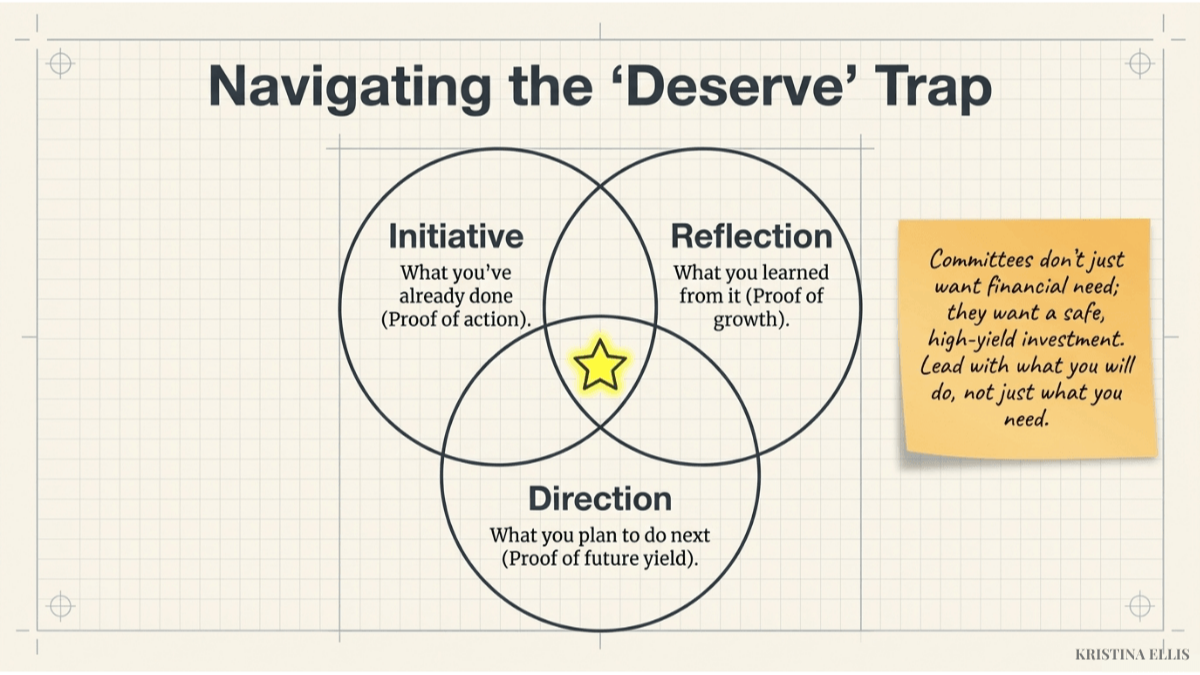
To answer this question well, you need to show:
-
What you've already done (proof of initiative)
-
What you've learned from it (proof of reflection)
-
What you plan to do next (proof of direction)
Don’t just say you deserve the scholarship. Show them you’re a good investment by giving proof of what you’ve done and where you’re headed.
Example answer structure:
"When I started tutoring ESL students at my school, I didn't know what I was doing. But after 18 months and 200+ hours, I'd helped 15 students pass their citizenship tests. That experience showed me I want to pursue education policy, and this scholarship would help me take the first step at [University], where I plan to major in public policy."
Notice what this does: it proves impact, shows reflection, and connects to future goals. All in a few sentences.
Step 7: Nail Your Conclusion
A lot of students waste their conclusion by just repeating themselves. Don’t fall into that trap.
Your conclusion has one job: leave the reader with a clear sense of who you are and where you're going.
Weak conclusion: "In conclusion, I would be honored to receive this scholarship because I am hardworking and dedicated to my future."
Strong conclusion: "The shelter breakfast program ended last year. But next fall, I'm starting a similar program at my university. And I already have three volunteers signed up."
The strong version ends with forward motion. It shows the reader that this story isn't finished. You're still building on it. That's what makes you memorable.
What Not to Write in a Scholarship Essay
Now that you know what works, let's talk about what doesn't.
Scholarship reviewers see the same mistakes again and again. Just avoiding these errors can put you ahead of most applicants before you even write a great sentence.
Mistakes that quietly disqualify scholarship essays:
1. Starting with clichés- "Ever since I was young" and "I've always been passionate about" are the two most overused openings in scholarship essays. Avoid them completely.
2. Writing like a resume- Your essay isn't a list of accomplishments. It's a story that proves who you are. If your essay could belong to any other applicant, it's not specific enough.
3. Using vague language- Words like "many," "various," and "things" tell the reader nothing. Replace them with numbers and specifics.
4. Focusing only on financial situation- Yes, scholarship providers want to help students with financial need. But they also want to invest in potential. Lead with what you'll do, not just what you need.
5. Trying to sound impressive instead of real- If your essay sounds like a press release, rewrite it. Judges want to meet a human, not a brochure.
6. Forgetting to answer the prompt- This seems obvious, but many students write great essays that don't actually address the question. Read the essay prompt three times before you start writing.
7. Submitting your first draft- The winning essay isn't the one that was written fastest. Revision is where scholarship money is made.
How to Write a 500 Word Scholarship Essay
Many scholarship opportunities require a specific word count, often 500 words or fewer. This limitation is actually your friend.
Short essays force you to be clear. You can't hide behind padding or filler. Every sentence has to earn its place.
Tips for short scholarship essays:
- Focus on one moment. You don't have room for your whole life story. Pick one scene that proves one quality.
- Cut your introduction. If your first paragraph is all background, delete it. Start in the action.
- Remove qualifier words. Words like "very," "really," "extremely," and "just" add nothing. Cut them.
- Check every sentence. Ask: Does this prove something about me? If not, it probably doesn't belong.
- Read it out loud. If you run out of breath, your sentences are too long.
A focused 500-word essay with one clear point almost always beats a rambling 1,000-word essay.
The 5 D's of Scholarship Essays (And How to Use Them)
The "5 D's" framework can help you check if your scholarship essay is working:
1. Detail - Does your essay include specific, concrete details? Names, numbers, sensory information?
2. Dialogue - Have you included any actual conversation? Even one line of dialogue makes your essay more vivid.
3. Discovery - Does the essay show you learning or realizing something? Readers want to see growth.
4. Direction - Is it clear where you're headed? Your essay should connect your past to your future.
5. Difference - Could another student write this exact essay? If yes, you need more specificity.
Run through this checklist before you submit. If you’re missing any of the 5 D’s, your essay probably needs another round of revision.
Scholarship Essay Examples: What Works and Why
Seeing what makes a winning essay work can help you write your own.
Example of a weak essay opening:
"Ever since I was young, I have always been passionate about education. I believe that education is the key to success, and I am committed to pursuing my dreams of attending college."
Why it fails: Generic language, no specific details, sounds like every other applicant. A scholarship committee member couldn't describe this student after reading it.
Example of a strong essay opening:
"The spreadsheet had 847 rows. Each row was a scholarship I'd found. By May, I'd applied to 112 of them. By August, I'd won 23."
Why it works: Specific numbers, immediate curiosity, and shows action instead of claiming a trait. The reader knows exactly who this student is within seconds.
Notice that the strong example doesn’t use fancy language. It’s simple, clear, and hard to forget.
How Scholarship Committees Actually Review Essays
Knowing how the review process really works can make your essay stronger.
I've been on both sides of this process - as an applicant who won over $500,000 in scholarships, and later as a judge reading applications myself. Here's what I can tell you about how it actually works.
Reality #1: Reviewers have a lot of responsibility.
A typical scholarship committee member might read 10-50 essays in a single review session. They're scanning, not studying. If your essay doesn't grab attention quickly, it gets passed over.
So what does this mean for you? Your opening sentences matter more than anything else. Don’t hide your main point on page two.
Reality #2: They're looking for reasons to say yes, and reasons to say no.
Reviewers want to find good candidates. But they also need to narrow the pool quickly. Essays with obvious problems (typos, off-topic responses, generic language) get eliminated first.
So before you focus on making your essay great, make sure you’re not making basic mistakes that could get you cut early.
Reality #3: Memorable beats impressive.
After reading 100 essays, what do reviewers actually remember? The specific stories. The ones with real detail, like a scene that captures exactly who this person is. When you're reading application number 47, the generic ones blend together. The specific ones don't.
So when in doubt, add detail. Specificity is what makes your essay stick in a reader’s mind.
Reality #4: They're pattern-matching to the scholarship's mission.
Every scholarship has a purpose - supporting students in a particular field, from a particular background, or with particular values. Reviewers are unconsciously checking: Does this student fit what we're looking for?
So do your homework on the scholarship provider before you write. Learn what they care about, and make it easy for them to see how you fit.
The Revision Process: Where Scholarship Money Is Made
First drafts don’t often win scholarships. It’s the revised drafts that do.
Most students think revision just means fixing typos. But that’s the most basic part. Real revision is about sharpening your message until no one can miss it.
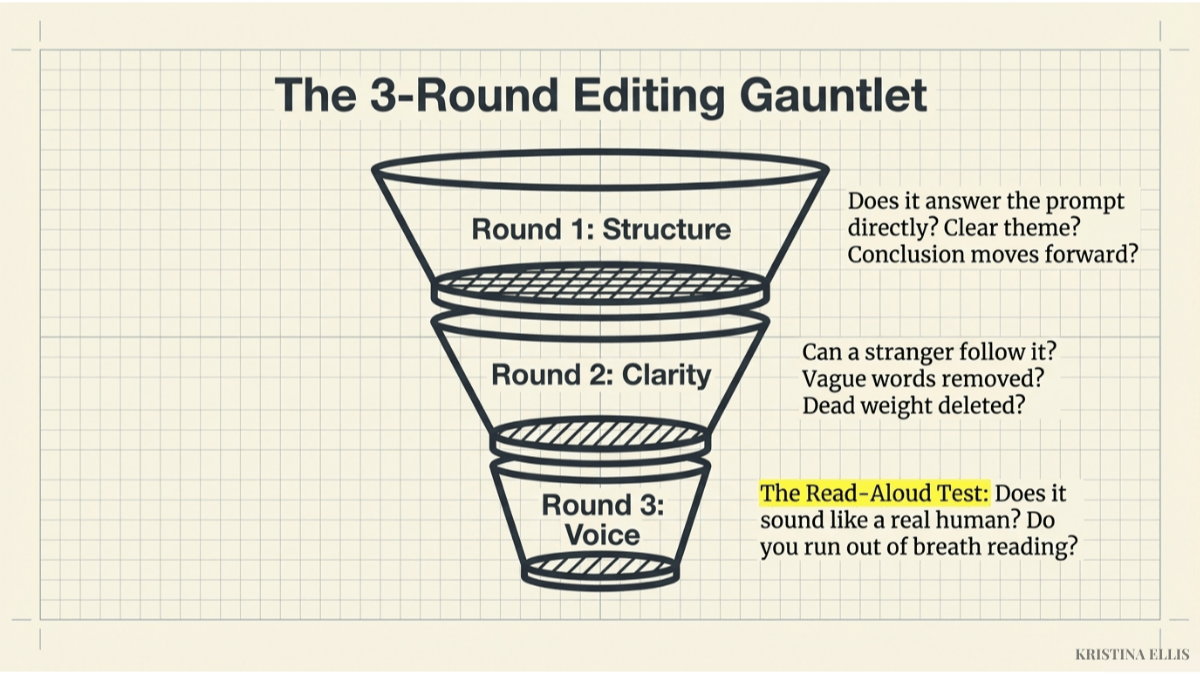
The 3-Round Editing System:
Round 1: Structure
-
Does the essay answer the prompt directly?
-
Is there one clear theme throughout?
-
Does the opening hook the reader?
-
Does the conclusion move forward (not just summarize)?
Round 2: Clarity
-
Can a stranger understand what happened in your story?
-
Are there vague words that should be replaced with specifics?
-
Is every sentence necessary?
-
Would removing any paragraph make the essay stronger?
Round 3: Voice
-
Does this sound like a real person (you)?
-
Would you actually say these sentences out loud?
-
Are there any phrases that sound like a brochure or press release?
-
Is there at least one line that only YOU could have written?
A lot of good writers send in essays that sound impressive but could belong to anyone. If your essay could fit another applicant, it needs more of your voice and more specifics.
The Read-Aloud Test:
Before you submit any scholarship essay, read it out loud. Your ear will catch problems your eyes miss, like sentences that run on, awkward phrases, or spots where you lose energy.
If you can’t read it smoothly, chances are the scholarship reviewers can’t either.
How to Recycle Essays (So You're Not Starting From Scratch Every Time)
Here's a secret that the most successful scholarship applicants know: the first application is the hardest. Every one after that gets easier, because you can recycle.
I called this out in my book Confessions of a Scholarship Winner because it was one of the biggest time-savers in my own process. Recycling application elements works exactly like traditional recycling. You take something you've already built, run it through a few adjustments, and make it usable again, stronger each time.
Once you've completed your first real scholarship application, you have a blueprint. You don't have to rethink your activities, re-excavate your best stories, or rebuild your personal narrative from scratch. You copy, customize, and improve.
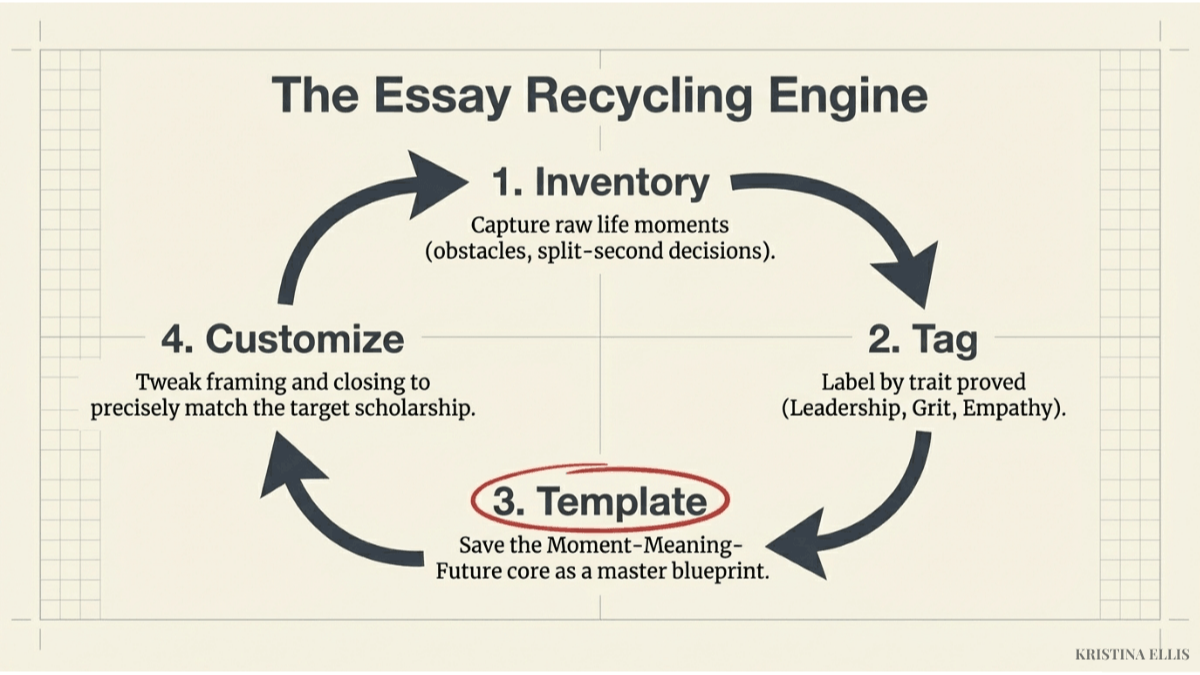
Here's how to build a recyclable essay system:
Start with your story inventory. Before you write a single essay, spend time reflecting on the moments that have made you who you are, like the obstacles you've overcome, the decisions you made under pressure, and the times you helped someone when no one asked you to. Write them down. These become your raw material.
Tag each story with the trait it proves. Scholarship committees are looking for specific qualities: leadership, resilience, initiative, empathy, work ethic, and purpose. After capturing a moment, ask yourself: What does this prove about me? A story about staying late to help a struggling teammate proves something different than a story about starting a project nobody else believed in. Know what each story demonstrates so you can match it to the right prompt.
Build your best essays into templates. Once you've written an essay you're proud of, don't abandon it. Save it. The core story (the scene, the meaning, the forward connection) can be adapted to fit dozens of different prompts. What changes is the framing and the emphasis, not the heart of the story.
Always customize before you submit. Recycling is not copy/paste without thinking. Every scholarship has a mission, and your essay should reflect that you understand it. Take the time to adjust your language, your focus, and your closing to speak directly to what that program cares about. A recycled essay that feels generic will cost you. A recycled essay that feels tailored will win.
Also, a strong recommendation letter can reinforce your story, because your recommenders are telling the same story from another angle.
The students who win the most scholarship money aren't writing new essays every time. They're refining the same great material and deploying it strategically. Work hard on the first few applications. Then put that work to work for you.
Common Scholarship Essay Prompts (And How to Approach Each One)
"Tell Us About Yourself"
This open-ended prompt seems easy, but it trips up a lot of students. The mistake is trying to cover too much at once.
Approach: Pick ONE quality that defines you and build the essay around it. Use one story that proves that quality. End with how it connects to your future.
"Describe a Challenge You've Overcome"
This is one of the most common prompts. It's also one of the most mishandled.
Don’t focus on how tough the challenge was. Focus on what you did and who you became because of it. Spend about 20% of your essay on the challenge, and 80% on your response and growth.
"Why Do You Deserve This Scholarship?"
Approach: Show evidence of past impact, reflection on what you learned, and a clear future direction. Make it easy for the scholarship committee to justify choosing you over other applicants.
"What Are Your Career Goals?"
Approach: Name a specific path (even if you're not 100% certain) and explain WHY it matters to you. Connect it to a real experience that sparked your interest.
"How Will You Use Your Education to Make a Difference?"
Approach: Be specific about HOW you'll create impact - not just that you want to. Reference your past actions as proof that you follow through on intentions.
"Tell Us About a Person Who Has Influenced You"
The trap here is spending your whole essay talking about the other person instead of yourself.
Use the person as a lens to show something about you. What did they teach you? How did it change what you do? The best essays about influential people are really about the applicant. They just use the relationship to tell the story.
Frequently Asked Questions About Scholarship Essays
How do you start a scholarship essay?
Start in the middle of a specific moment, not with dry background or context. Give readers action, tension, or a surprising detail that makes them want to keep reading. Avoid quotes, dictionary definitions, and phrases like "Ever since I was young." For more on crafting your opening lines, see how to start a scholarship essay.
What's a good hook for a scholarship essay?
The best hooks put readers inside a scene immediately. Use concrete details, a specific moment, or a tension that creates curiosity. The goal is to make scholarship reviewers forget they're reading an application and feel like they're meeting a real person.
How do I make my scholarship essay stand out?
Specificity is what makes essays memorable. Replace vague claims with concrete proof. Use numbers, names, and sensory details. Choose a unique angle on common topics. And make sure your voice comes through - write like a human, not a brochure.
What should I NOT write in a scholarship essay?
Avoid clichéd openings, vague language, resume-style lists, and generic claims without proof. Don't focus only on financial need. Don't try to sound impressive instead of real. And don't submit without proofreading for basic errors.
How to write a 500 word scholarship essay?
Focus on one moment and one clear point. Cut your introduction if it's all background. Remove qualifier words. Make every sentence prove something about you. Read it aloud to check flow. Short essays require more precision, not less effort.
What GPA will get you a full ride scholarship?
There's no single GPA that guarantees scholarship success. I was ranked 32nd in my class of 182 - not the obvious top candidate. Many scholarships focus on specific traits, backgrounds, or fields rather than grades alone. Your essay, activities, and overall story matter just as much as your numbers.
How do I answer "Why do I deserve this scholarship?"
Don't focus on what you need. Show what you've done, what you've learned from it, and what you plan to do next. Prove you're worth investing in through evidence of past action and future direction.
The Bottom Line on How to Write a Scholarship Essay
Scholarship essays aren’t about being the most impressive person in the room. They’re about being the most memorable and believable.
I won over half a million dollars in scholarships, and I wasn’t the obvious pick. I wasn’t the valedictorian or the all-star athlete. What made the difference was learning how to paint a clear, specific, honest picture of who I was and where I was headed. That’s what worked.
The students who win money for college aren’t always the ones with the best grades or the biggest stories. They’re the ones who can clearly show who they are, what they’ve done, and why they’re worth investing in.
Start with a real moment. Add specific proof. Connect it to your future goals. And make it easy for busy readers to remember you when they’re sorting through the pile.
That's how you write a scholarship essay that wins.

Kristina Ellis
Bestselling Author · Coca-Cola Scholar · Gates Millennium Scholar
Kristina won over $500,000 in scholarships to attend Vanderbilt University debt-free and has helped thousands of families fund college without loans. She's a former co-host of The Ramsey Show and author of Confessions of a Scholarship Winner.